AI Automation for Small Business Checklist: 10-Point First-Task Scorecard
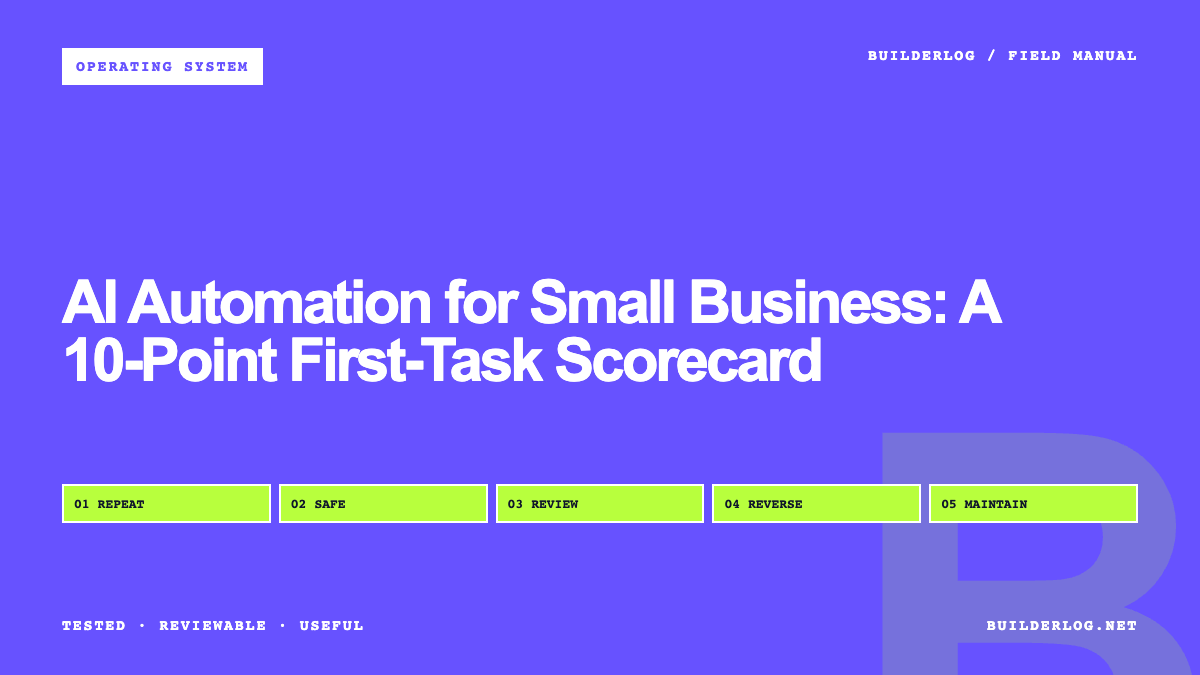
AI automation for small business should start with one boring, reversible task—not a new tool stack. Use the 10-point scorecard below to test repeatability, input safety, reviewability, reversibility, and maintenance. Connect no live account until one candidate scores well and a person can inspect the result.
The short answer
Reviewed on 2026-07-29 under these conditions: the reader is a small-business owner without a dedicated automation team, the first test uses fictional or approved non-sensitive inputs, and no customer message, payment, publication, deletion, or permission change happens automatically.
Start with a task that:
- happens often enough to observe;
- accepts a consistent, approved input;
- produces a draft or classification a person can verify;
- can fail without contacting anyone or losing data; and
- has an owner who can maintain the source, rule, and fallback.
Do not begin with refunds, payroll, legal decisions, health information, live customer replies, or account permissions. Those tasks combine high error cost with difficult reversal.
Before connecting a tool, make a free browser workflow starter for one non-sensitive recurring task. The local result makes the first pilot concrete without sending the input.
Want the smallest paid next step? See the $5 First-Task Operating Kit before checkout → It keeps one bounded task, review gate, privacy boundary, and stop rule in copy-ready self-serve text; it is not implementation or a results guarantee.
What current public evidence says—and does not say
The U.S. Census Bureau reported that business AI use hovered between 17% and 20% from December 2025 to May 2026. It also reported that fewer than 20% of firms with four or fewer employees used AI. A separate Census working paper placed firm use at 18% in its reference period and found that 57% of adopting firms used AI in three or fewer business functions.
Those figures do not show that AI produced a return. They show that adoption is real, uneven by firm size, and commonly narrow inside the firms already using it.
The OECD’s 2026 D4SME survey covers a non-representative sample of more than 2,000 SMEs in 12 OECD countries. It says strategic, targeted, and secure integration remains uneven, while time constraints, maintenance costs, and skills gaps continue to impede implementation. The sample limitation matters: it is evidence of recurring barriers, not a population estimate for every small business.
The U.S. Small Business Administration recommends starting small, testing whether a tool adds value, and having a person review AI outputs. It lists repeat tasks and content drafting as possible uses, but its examples are guidance rather than proof that a particular workflow will be accurate, safe, or profitable.
The practical reading is modest: choose one narrow task that exposes its own failure. Do not treat adoption statistics as an instruction to automate more.
| Public evidence | What it supports | What it does not prove |
|---|---|---|
| Census business-use data | Adoption is measurable and lower among the smallest firms | Profit, saved hours, or implementation quality |
| Census diffusion paper | Many adopters use AI in a limited number of functions | That a wider rollout is better |
| OECD SME survey | Time, maintenance, skills, and secure integration are recurring barriers | A representative rate for every SME |
| SBA guidance | Start small, test value, and review outputs | That any vendor or workflow is safe by default |
Copy the 10-point first-task scorecard
List three recurring tasks. Give each task 0, 1, or 2 points for every gate.
| Gate | 0 points | 1 point | 2 points |
|---|---|---|---|
| Repeatability | Every case is different | A pattern exists, but exceptions are frequent | The input and finished artifact repeat clearly |
| Input safety | Requires secrets or sensitive customer data | Can be redacted with effort | Can be tested with public, fictional, or approved non-sensitive data |
| Reviewability | Quality is subjective or hard to check | A reviewer can check part of it | A named person can verify it against explicit acceptance checks |
| Reversibility | Failure sends, pays, deletes, or changes access | Recovery is possible but manual and slow | Failure creates only a draft and the old path remains |
| Maintenance | No owner or source of truth exists | An owner exists, but change checks are unclear | An owner, source, review date, and fallback are named |
Add the five scores. Use this operating rule:
- 8–10: eligible for a bounded draft-only pilot;
- 5–7: keep it manual and improve the source, checks, or fallback first;
- 0–4: do not automate this task now.
These thresholds are Builderlog’s conservative pilot rule. They are not Census, OECD, or SBA standards, and they have not been tested as a performance predictor.
Copy this worksheet:
Candidate task:
Current owner:
How often it happens:
Finished artifact:

Repeatability (0-2):
Input safety (0-2):
Reviewability (0-2):
Reversibility (0-2):
Maintenance (0-2):
Total (0-10):

Approved test input:
Acceptance checks:
Human reviewer:
Stop condition:
Manual fallback:
Receipt to keep:
Worked example: draft an FAQ reply without sending it
Consider a business that repeatedly answers questions already covered by a public FAQ.
The test input is a fictional question based on that FAQ. The proposed result is a reply draft stored in a test document. The reviewer checks whether the answer uses the approved FAQ, includes every relevant condition, avoids inventing a policy, and matches the business tone. Sending remains outside the test.
A possible score is:
| Gate | Score | Reason |
|---|---|---|
| Repeatability | 2 | The same known FAQ categories recur |
| Input safety | 2 | Fictional questions and public FAQ text are sufficient |
| Reviewability | 2 | The reply can be checked against a named source and acceptance list |
| Reversibility | 2 | A rejected draft contacts nobody |
| Maintenance | 1 | The FAQ owner exists, but the change-review schedule is not yet written |
| Total | 9 | Pilot only after the review schedule is added |
This is not evidence that the reply will be correct. It is evidence that a failed trial can stay visible and contained.
Compare that with an automatic refund decision. It may recur, but it touches payment, customer-specific facts, policy exceptions, fraud risk, and irreversible communication. Even a fluent explanation cannot make those boundaries disappear. Keep that task manual.
Run one reversible pilot and keep a receipt
For an eligible task, run the old manual path and the draft-only path side by side. Do not measure a vague feeling of speed. Keep one receipt per attempt:
Run date:
Input version:
Source version:
Draft created:
Acceptance checks passed:
Corrections required:
Exception found:
External action taken: no
Stop condition triggered:
Manual fallback used:
Reviewer:
After several receipts, inspect the corrections. If the same source gap or exception repeats, fix the workflow before adding tools. If a reviewer must guess, the acceptance check is incomplete. If the source changes without an owner noticing, maintenance has failed even when the generated draft looks good.
Only widen the pilot when the inputs, checks, stop rule, and fallback remain stable. A polished demo or one accepted draft is not a reliability record.
Failure modes and who should not use this approach
This scorecard can still produce a bad decision.
- A team may overrate reviewability because the output sounds professional.
- Fictional inputs may omit the messy exceptions found in real work.
- A source owner may exist on paper but never review changes.
- Maintenance cost may appear only after a tool, model, API, or policy changes.
- A draft-only task may later gain a send button without a fresh risk review.
Do not use this article as legal, security, employment, financial, or compliance advice. Do not put personal information, credentials, confidential customer records, payment data, or regulated data into a test because a tool advertises a free tier. A business with those requirements needs context-specific review before connecting an AI system.
Related Builderlog field manuals:
- AI Workflow for Beginners: A Five-Box Map Before Automation
- The OpenAI–Hugging Face Incident: AI Agent Safety Checks
Final decision and source boundary
For a first small-business AI automation, choose the highest-scoring draft-only task, not the most impressive demo. Require a safe input, explicit checks, a named reviewer, a stop condition, a manual fallback, and a receipt. If the task scores below 8, repair the manual workflow before automating it.
Sources reviewed 2026-07-29:
- U.S. Census Bureau: Large Firms With at Least 20 Employees Biggest AI Users
- U.S. Census Bureau: The Microstructure of AI Diffusion
- OECD: Empowering SMEs in the age of AI
- U.S. Small Business Administration: AI for small business
The sources support the adoption context, implementation barriers, narrow-start guidance, and human review. They do not validate this scorecard or establish a revenue, productivity, safety, or accuracy result.
Score the task before choosing the tool. Pilot only a safe, reviewable, reversible draft task with a named owner and fallback.
Need the repeatable version after the first task? See the $19 AI Work Starter System → It adds 44 local files, six ledgers, and filled synthetic examples; it is a self-serve download with no result guarantee.