AI Content Review Checklist: Check Facts, Context, and Permissions
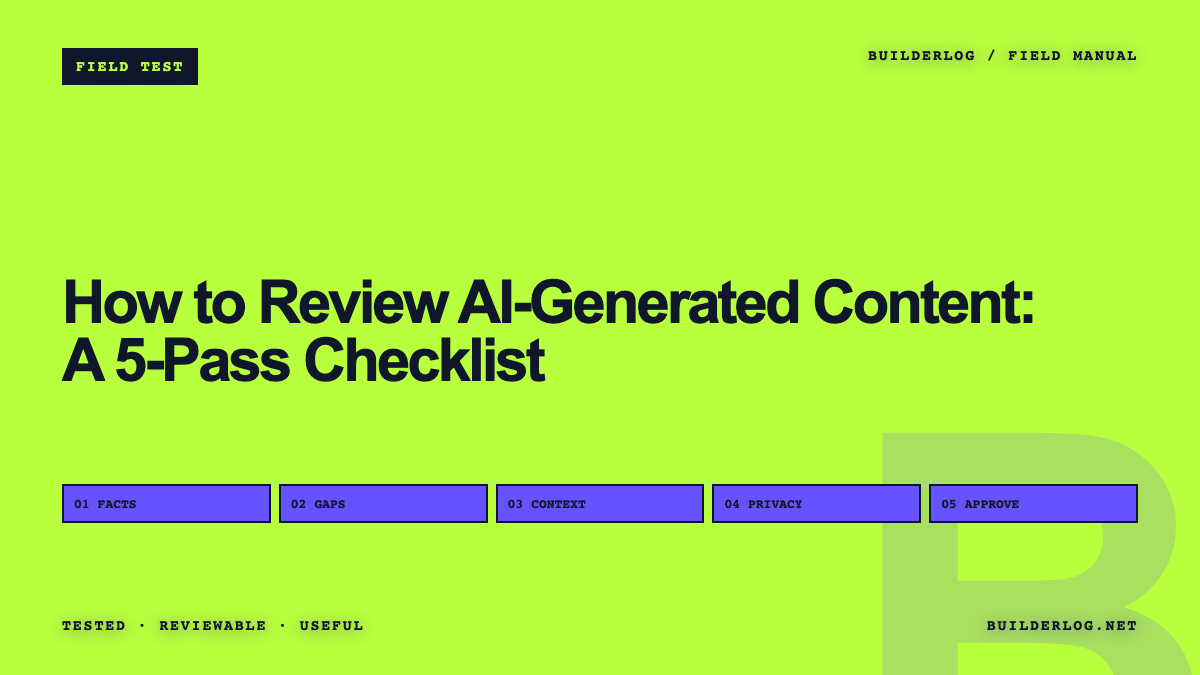
Quick answer: Review AI-generated content faster without cutting corners: check facts, missing requirements, context, sensitive data, and final approval before sharing.
Search intent tested:
ai content review.
Quick answer: Review AI-generated content faster without cutting corners: check facts, missing requirements, context, sensitive data, and final approval before sharing.
Search intent tested:
first pass review.
If you are learning how to review AI-generated content, do not start by asking whether it sounds polished. Check the draft in five passes: facts, missing requirements, audience and context, sensitive data and permissions, then final approval. Keep the source beside the draft, mark uncertainty instead of repairing it from memory, and do not send or publish until a named person makes the final decision.
Want to use the review instead of saving another checklist? Make a free review receipt in your browser → Check the brief, human review gate, and stop rule without signup or upload.
Prefer a concrete workflow before choosing a file? Generate a free local workflow result → See the review gate in a reusable result before considering the optional $5 kit; no signup or upload.
Want to inspect the review flow first? View the free audit sample → The paid review is no longer available. You can still read the free synthetic sample with three priority fixes and one acceptance test.
The short answer and review conditions
This guide was reviewed on 2026-08-03 for one low-risk condition: a beginner is checking a synthetic business update before it is shared. It does not test legal, medical, financial, employment, or safety-critical content. It does not prove that a checklist prevents errors or that AI improves content quality.
The method turns “looks good” into a review receipt. For each pass, record what was checked, what source supports the decision, what remains unknown, and whether the draft is ready, needs edits, or must stop.
OpenAI Academy’s workflow worksheet, dated 2026-07-07, asks teams to define required sources, expected output, a human review point, and stop-or-escalate conditions before an AI-supported workflow acts. Its evidence guide, dated 2026-07-17, separates quality signals such as accuracy, completeness, consistency, corrections, test cases, and review scores. It also warns that a review control is not proof that errors never occur. NIST’s Generative AI Profile is a broader voluntary risk-management resource; it supports source and accuracy checks but does not prescribe the five-pass artifact below.
Copy the five-pass review checklist
Use the same order every time. Later passes should not hide a failure found earlier.
| Pass | Question | Evidence to inspect | Stop when |
|---|---|---|---|
| Facts | Can every material name, date, number, quote, and claim be traced? | Approved source, original record, or clearly labeled synthetic input | A claim has no reliable source or conflicts with one |
| Missing requirements | Does the draft answer the actual request and include every required field, section, and constraint? | Request, brief, template, acceptance criteria, or checklist | A required item is absent or the request is ambiguous |
| Audience and context | Is the meaning accurate for this reader, situation, and channel? | Audience note, prior approved example, terminology guide, and surrounding context | Tone or wording could change the intended decision |
| Sensitive data and permissions | Is every detail allowed to appear, and may this asset be reused here? | Data policy, consent, license, attribution, and access rule | Personal, confidential, copyrighted, or unapproved material is present |
| Final approval | Does an accountable person accept the exact version that will be sent or published? | Final preview, change log, unresolved questions, destination, and approver | The destination changed, the content changed, or no approver is named |
Copy this receipt under the draft:
Draft and intended destination:
Approved sources used:
Facts checked:
Missing requirements found:
Audience or context edits:
Sensitive data or permission issues:
What remains unknown:
Final version changed after review: yes / no
Decision: stop / revise / approve this version
Approver:
Review date:
The receipt is deliberately small. It makes the decision inspectable without pretending to measure accuracy automatically.
A synthetic draft shows why the order matters
Consider this invented customer update:
Your replacement will arrive on Friday. We have already approved a full refund. Call the account manager directly if it does not arrive.
The synthetic source packet says only that a replacement request was received. It contains no confirmed arrival date, no approved refund decision, no permission to expose a direct phone number, and no named owner for sending the message.
The facts pass stops the unconfirmed arrival date and refund claim. The missing-requirements pass asks for the approved next step and escalation rule. The context pass replaces certainty with a clear statement of what is known. The sensitive-data pass removes the direct contact detail. The approval pass keeps the message as a draft until the responsible owner accepts the exact final version.
A safer revision would say:
We received your replacement request. The delivery date and refund status are not yet confirmed. The support owner will update this thread after those details are verified.
This is a worked example, not evidence that the wording is correct for a real company. A real reviewer would need the organization’s policy, case record, channel rules, and authority to approve the reply.
Review the source, not just the sentence
Fluent writing can make unsupported claims harder to notice. Open the source and compare the draft against it. Do not ask the same draft to prove itself.
For a summary, compare each conclusion with the relevant passage. For a spreadsheet narrative, verify units, date ranges, filters, and the source of each number. For a customer message, verify policy, consent, account state, and who may make the promise. For a public post, verify image rights, quotations, names, and whether the destination changes the risk.
When sources disagree, record the conflict. Do not select the most convenient value. When a source is missing, use “unknown” or stop. When a requirement is unclear, return to the request owner rather than guessing what the reader meant.
Failure modes and limits
This checklist can fail when the reviewer lacks subject expertise, cannot access the source, rushes through repeated approvals, or reviews only wording while ignoring the destination. It can also become busywork if every low-impact draft receives the same depth of review.
Do not use this article as a substitute for qualified review in regulated or high-impact work. Do not place confidential or personal material into an unapproved tool merely to check it. Do not infer that a draft is safe because it passed one synthetic example.
The stop rule is simple: if a material claim, required input, permission, or accountable approver is missing, keep the output as a draft.
Final decision and sources
Review AI-generated content as a decision artifact, not a prose sample. Facts come first, then completeness, context, data and permission boundaries, and approval of the exact final version. A polished sentence cannot compensate for a missing source or missing authority.
Sources reviewed 2026-08-03:
- OpenAI Academy: AI workflow starter worksheet
- OpenAI Academy: Gather appropriate evidence of value
- NIST AI RMF: Generative Artificial Intelligence Profile
These sources support explicit review points, approved sources, quality evidence, source checking, limits, and escalation. They do not validate this five-pass sequence or guarantee a correct result.
Related Builderlog field manuals:
Take one unsent AI draft, copy the receipt, and complete all five passes before you share it.
Check facts, missing requirements, context, sensitive data and permissions, then final approval. Stop when a material source or decision owner is missing.