Route research, production, skeptical review, and final packaging by failure mode—not by tool brand.
NO CODE · ONE REPEATED TASK · 30-MINUTE FIRST RUN
Turn one recurring task into a one-page brief, review checklist, and completion receipt — in 30 minutes.
Define the result, give AI only the allowed inputs, review the exact output, and leave a completion record. Start with one free browser utility. Inspect the six-file First-Task Kit only when that first loop is useful.
Generate the free workflow result first → Shipping an AI app? Run the free 5-check test → Start with the smallest paid step — see the $5 kit first →
Instant local download · no signup or subscription · 30-day digital-download refund on Gumroad · No testimonials or performance claims; inspect the free sample first.
Need a lead follow-up tracker? Free CSV →
START FREEOne brief, one review gate, one completion receipt
UPGRADE FOR $5Six focused files for one task, one review gate, and one receipt
RISK BOUNDARY30-day digital-download refund policy on Gumroad
RUN THE FIRST LOOP BEFORE YOU BUY
If these seven lines do not help, do not buy the larger pack.
RESULT
What must exist when the task is done?

ALLOWED INPUTS
What may AI read?

THREE CHECKS
What makes the result acceptable?

HUMAN OWNER
Who reviews the exact final version?

STOP RULE
When must the work pause?
Use one free browser utility on a real but non-sensitive task.
It gives you a first action, a finished artifact, a human review gate, and a stop rule in the browser. No email, account access, or upload is required.
Generate the free workflow result → Or inspect the local Control Room demo →NOT A CODING COURSE
The missing layer between “ask AI” and “the work is actually done.”
Transfer verified facts, decisions, files, boundaries, and open work without forwarding the whole conversation.
Use acceptance checks, privacy filtering, and completion receipts so “done” means something observable.
WHAT IS INSIDE
Everything is grouped around starting, checking, and repeating one task.
Use the outcome brief, task-fit check, 30-minute first run, and four filled examples to choose one finishable job.
Separate making from review. Check facts, privacy, rights, scope, links, and external-action authority before release.
Use the local Control Room and six CSV ledgers to record evidence, corrections, time, cost, failures, and the next decision.
New in v1.7: open one local HTML file and start with synthetic data immediately. Track outcomes, evidence, cost, time, failures, and release approval visually; no customer result is invented.
See the larger 44-file map for context
The older v1.7 archive contains 44 files. This map is reference material, not the active checkout; the current paid route is the six-file First-Task Kit at $5.
15 filescore briefs, gates, playbooks, README, and control room 5 filesAI adoption-fit checks 4 filesworked examples 6 fileslocal control-room CSV ledgers 6 filessmall-business workflow pilot 8 filesbonus product-validation pack
The free AI utility library is available separately, so you can test the working style before paying.
Local files only. No account access, data transmission, subscriptions, or dependency on a specific AI provider. Results, traffic, and revenue are not guaranteed.
START WITH THE ARTIFACT, NOT THE TOOL
Four kinds of work. One completion loop.
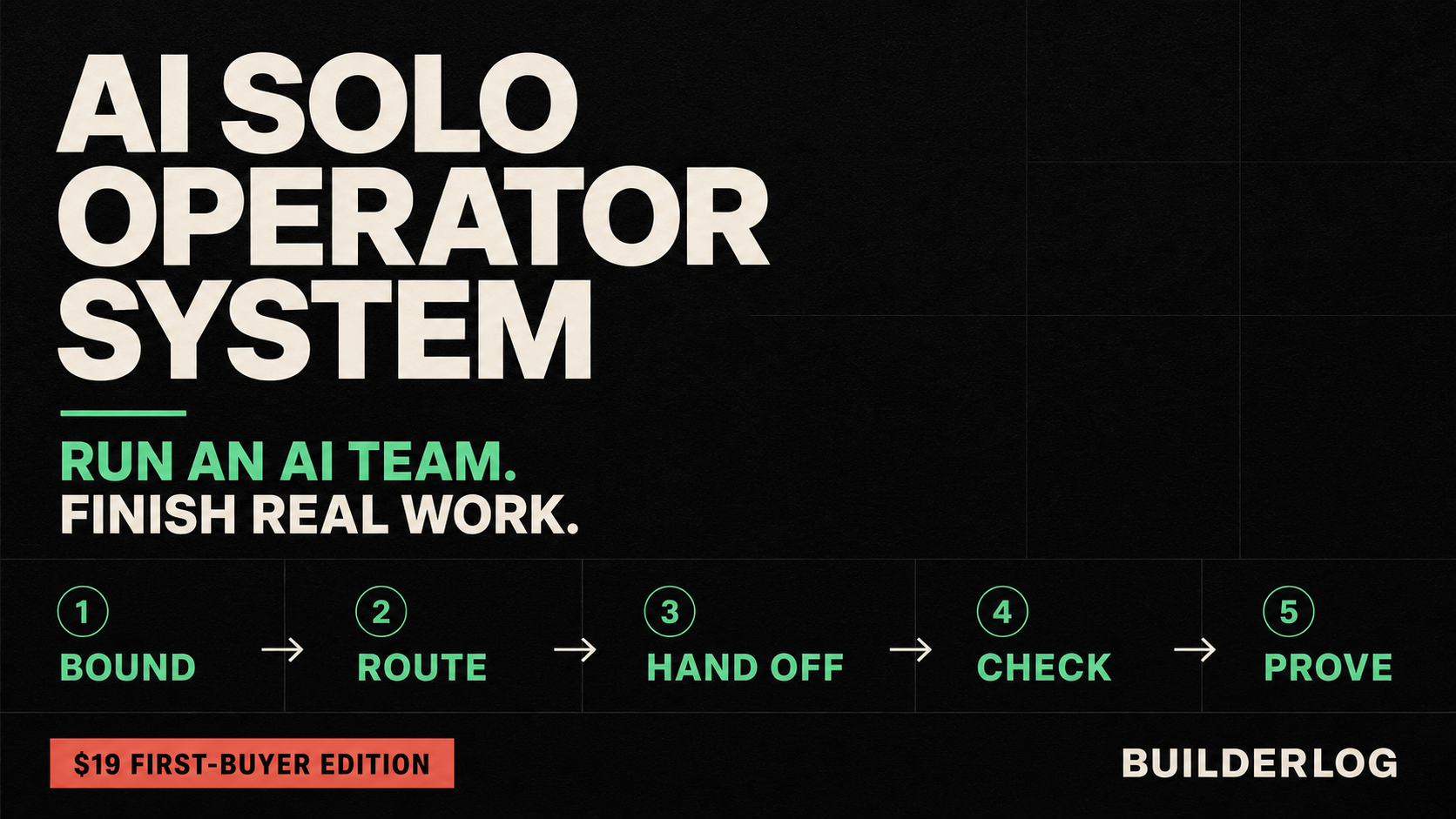
Choose the finished artifact first. The same bound → route → hand off → check → prove → learn method then adapts to the work instead of forcing every task into a development project.
Input: one decision and current sources.
Finish: a comparison, recommendation, unknowns, and next actions.
Check: source dates, contrary evidence, and unsupported conclusions.
Input: approved facts and one audience.
Finish: a channel-ready asset with a clear takeaway.
Check: claims, originality, privacy, destination, and publication authority.
Input: one recurring problem and reusable knowledge.
Finish: tested files, buyer instructions, a purchase path, and a version record.
Check: every sales-page promise against the actual archive.
Input: a real trigger, owner, examples, and exceptions.
Finish: a minimal SOP with review points and stop rules.
Check: one synthetic dry run before any live or external action.
ONE ACTIVE PAID START
Try the free result first, then inspect the exact $5 kit.
The active paid route is intentionally small: six files for one recurring task, with the scope, refund policy, and limits visible before checkout. A price change requires an independently verified sale; none has been recorded.
Gumroad currently lists a 30-calendar-day digital-download refund policy. A refund ends the license and the files must be deleted. The policy does not guarantee a business result, compatibility with every tool, or a change in traffic or revenue.
$5